
Interoception Exercises: How to Notice Hunger, Thirst, and Body Signals
Quick note: If your body feels like a mystery today, start with the quick guide below. Pick one thing, try it for five minutes, then stop. You're not behind.
Quick start guide
- Feeling foggy and disconnected? Do a 60-second body scan. Start at your forehead and move down. Name sensations like "pressure," "warmth," "hunger," "buzzing," or "nothing yet."
- Forgetting basic needs? Set a single timer for the next check-in. When it goes off, ask three questions: "Do I need water? Food? Bathroom?" Write the answers down.
- Signals too loud or panicky? Try paced breathing for two minutes (inhale 4, exhale 6). It turns the volume down so you can listen again.
- Can't tell what you're feeling? Use a simple scale. "How hungry am I from 0 to 5?" "How tense from 0 to 5?" A number is easier than a perfect word.
Introduction
Interoception is your brain's internal status feed: hunger, thirst, heartbeat, nausea, temperature, pain, and that "I need to pee" flicker that shows up mid-meeting. When that feed is fuzzy, you can miss basic needs until they become urgent. That can look like skipping meals, forgetting water, or suddenly realizing you've been holding it for an hour.
If that sounds familiar, you're not broken. Interoception can be inconsistent for lots of people, and it's especially common in neurodivergent brains. You can learn to notice it sooner and respond without waiting for the emergency level.
This guide covers what interoception is, why it gets muddy, how it shows up in daily life, and practical exercises that make your body signals easier to read. For the bigger picture on how interoception works and why it differs for neurodivergent people, start with the interoception hub.
What interoception is (and isn't)
Interoception is the nervous system's way of sensing, interpreting, and integrating signals from inside your body. It's a continuous map of your internal state, both conscious and unconscious, and it feeds into emotions, urges, and self-regulation.
Interoception isn't the same as:
- Proprioception, which tells you where your body is in space.
- Exteroception, which covers external senses like sight, sound, smell, taste, and touch.
- Missing internal signals, which is an input clarity issue, not a motivation problem.
When interoception works well, you notice a need early and respond gently. When it doesn't, the signal arrives late, comes through distorted, or gets drowned out by everything else.
See it explained in plain language
If you want a quick walkthrough before diving into exercises, this short talk is a strong intro to how interoception feels in real life.
Why interoception can get blurry
Interoception isn't a single sense. It's a network of signals moving through the nervous system and getting filtered by attention, stress, and context. That means it can get noisy or inconsistent for many reasons.
- Chronic stress can mute quieter needs.
- Hyperfocus can keep your attention locked elsewhere.
- Sensory overwhelm can drown out internal cues.
- Some people disconnect from body signals after trauma.
- Neurodivergent processing can lower interoceptive accuracy.
You might notice interoception problems in one area and not another. That's normal. You're aiming for earlier, gentler awareness, not a perfect read on every signal.
Your brain also predicts what your body should feel like. If your day is packed and you're used to pushing through, the prediction can override the signal. That can explain why you feel "fine" and then suddenly crash.

How it shows up in daily life
- You forget to eat until you're shaky, irritated, or nauseous.
- You realize you're thirsty only after a headache hits.
- You hold your bladder until it hurts because you missed the early signal.
- You can't tell if you're tired or overstimulated.
- You feel "off" but can't name what your body is asking for.
- You get sudden nausea or dizziness that feels like it came out of nowhere.
- You eat or drink fast because your body only signals in emergencies.
It can also look like mislabeling. Hunger might feel like anxiety. Thirst might feel like a headache. When signals are blurry, your brain grabs the closest label it has. The fix is better data, not scolding.
Interoception exercises that actually help
These strategies build a clearer signal. Start small and repeat. Consistency matters. Intensity alone doesn't.
1. The 90-second body scan
Set a timer for 90 seconds. Move your attention slowly from head to toe and label whatever shows up: tension, warmth, pressure, fluttering, emptiness, or "nothing yet." The label is the point. If you get distracted, gently come back.
Why it works: labeling the sensation tells your brain that internal cues matter, which makes them easier to notice later.
2. The three-question check-in
Use this when you transition between tasks.
- Do I need water?
- Do I need food?
- Do I need the bathroom?
Write the answers down or say them out loud. If you can't tell, pick a small, safe action like a few sips of water, a handful of something, or a quick bathroom break.
3. Hunger and fullness scales
A simple 0-5 scale makes early signals easier to catch.
- 0 = empty, shaky, or nauseous
- 2 = light hunger
- 3 = comfortable
- 4 = comfortably full
- 5 = too full
Check in once before a meal and once 20 minutes after. You're building calibration, not rules.
4. Temperature checks
- Ask: "Am I hot, cold, or ok?"
- If you're unsure, touch the back of your neck or wrists.
- Add or remove one layer and re-check in five minutes.
5. Interoceptive anchors
Anchors are predictable routines that cue your body scan without relying on memory.
- After you make coffee or tea
- Before opening your laptop
- When you enter the bathroom
- When you charge your phone
Pick one anchor and link it to a 20-second internal check.
6. Eat and drink by structure
If cues arrive late, structure is a kindness. Think of it as a baseline, not a diet.
- A simple breakfast within two hours of waking
- A water bottle you finish by noon
- A snack bridge between lunch and dinner
7. Low-effort body movement
- Stretch your calves and shoulders for 30 seconds.
- Walk to the end of the hall and back.
- Do five slow squats and notice your breath.
8. Emotion-body mapping
- Tight chest can mean anxiety or stress.
- Heavy limbs can mean fatigue or low energy.
- Hot face can mean embarrassment or anger.
- Hollow stomach can mean hunger or worry.
You don't have to be right. You're building a habit of checking the body first.
9. The half-meal pause
If you tend to eat fast because you notice hunger late, pause halfway through a meal. Take three breaths and ask, "Do I still feel hungry?" It helps your brain notice fullness before it's too late.
10. Sensory-friendly hydration
- Use a straw or insulated bottle.
- Add a small flavor cue like lemon, mint, or a splash of juice.
- Set a visual cue so water stays next to your phone or keyboard.
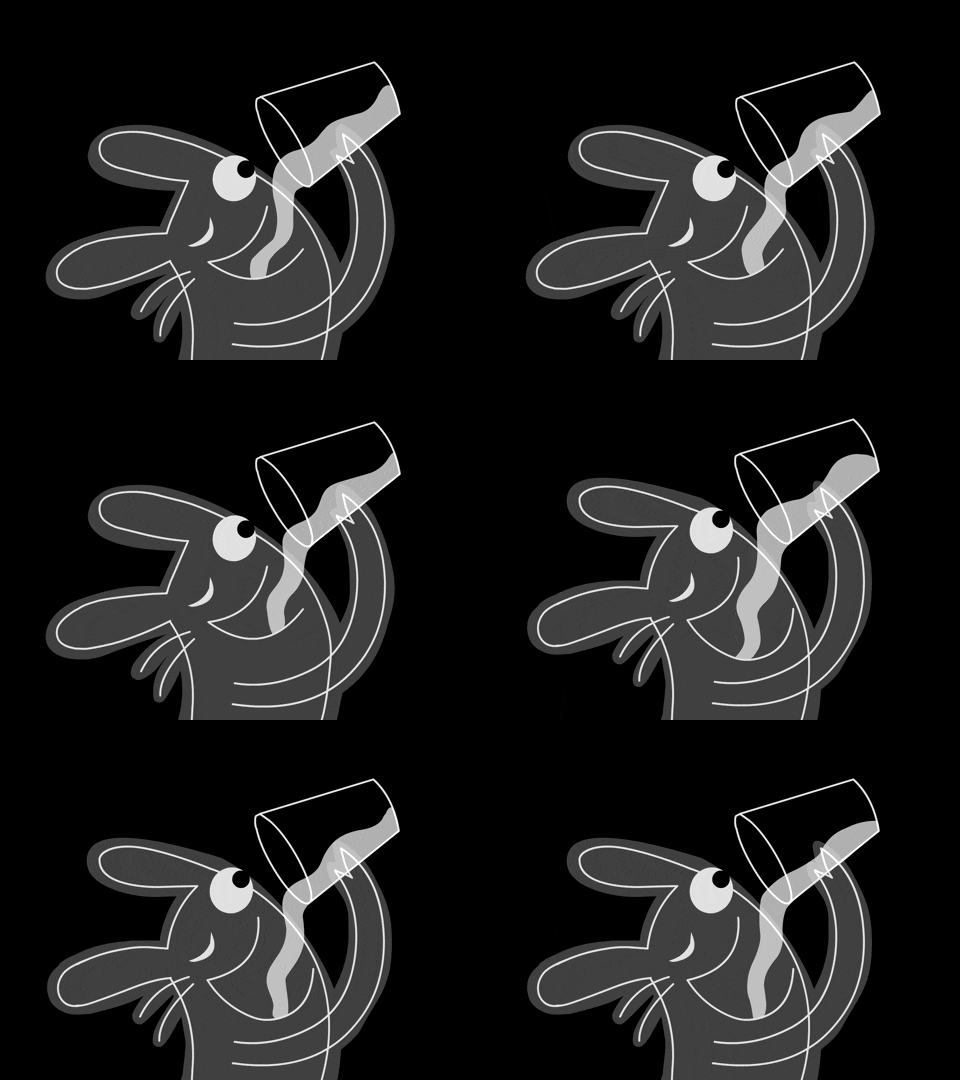
11. The two-sip rule
If drinking water feels like a chore, make the first step tiny. Every time you pass your bottle, take two sips. That's it. No giant goals. It adds up fast, and it teaches your brain that hydration can be low-effort. If you miss a pass, nothing breaks. You'll catch the next one.
12. Bathroom pre-commit
Some people miss bladder cues until they're urgent. Try a simple pre-commit: every time you stand up, ask yourself if a bathroom trip would prevent a problem later. You don't have to go every time. You're just making it a default check.
What not to do
- Don't wait for perfect signals. Use small, safe actions when you're unsure.
- Avoid all-or-nothing rules like "I have to feel hungry to eat."
- Skip the shame loop. Feeling bad at body awareness makes signals quieter.
- Don't use interoception as a new way to judge yourself.
- Loading five new habits at once usually leads to dropping all of them.
When to consider professional help
Interoception issues can overlap with anxiety, trauma, eating disorders, GI conditions, or chronic pain. If any of these are true, it might help to talk to a professional:
- You regularly miss meals or fluids and feel physically unwell.
- Panic symptoms that feel like they come out of nowhere.
- Body sensations trigger fear or avoidance.
- A history of disordered eating.
- Pain, dizziness, or GI symptoms are frequent and unexplained.
A clinician can help you sort out whether the issue is interoceptive, medical, or both. Occupational therapists, trauma-informed therapists, and some dietitians can help with interoception work and gentle routines.
Long-term management: building trust with your body
Interoception improves with repetition and lower stakes. Think of it like strengthening a weak signal rather than fixing a broken system.
Try a simple weekly plan:
- One daily check-in anchor
- One hydration structure
- One meal timing baseline
- One two-minute body scan most days
If that's too much, cut it in half. Interoception doesn't need intensity. It needs consistency.
Over time, you'll notice earlier cues. Hunger feels less like a crash. Bathroom signals come with more warning. You'll start to trust yourself again.
If you want to build regulating input into your day more deliberately, a sensory diet for adults is the next step up from single check-ins.
Conclusion
Interoception is the body's internal messaging system. When the message is late or garbled, basic needs get missed. The fix is a few low-friction practices that make those signals easier to hear, not trying harder or blaming yourself.
Start small. Repeat what works. Treat every check-in as a win, not a test.
Save the date
Come to NeuroDiversion 2027
An annual gathering in Austin, built by and for neurodivergent people—designed around what the nervous system needs. Quiet rooms, real talk, good company.
Join us in AustinWant to learn more with the community?
If this article helped, you'll probably like the broader NeuroDiversion event experience. It's built for neurodivergent people, parents, educators, and allies who want practical tools and honest conversations.
Explore the NeuroDiversion eventReferences
- Khalsa SS, Adolphs R, Cameron OG, Critchley HD, Davenport PW, Feinstein JS, et al. Interoception and Mental Health: A Roadmap. Biological Psychiatry: Cognitive Neuroscience and Neuroimaging. 2018;3(6):501-513. https://doi.org/10.1016/j.bpsc.2017.12.004
- Yang HX, Zhou HY, Li Y, Cui YH, Xiang Y, Yuan RM, et al. Decreased interoceptive accuracy in children with autism spectrum disorder and with comorbid attention deficit/hyperactivity disorder. Autism Research. 2022 Apr;15(4):729-739. https://doi.org/10.1002/aur.2679
Disclaimer
This article is for informational purposes only and is not medical advice. For diagnosis or treatment planning, talk with a qualified health professional.
Last updated: February 18, 2026